Vacation Dreams

Category: Main article

  • Write in (3)

    The initial attraction to visiting Christchurch was its colonial buildings and beautiful gardens. With only one day to enjoy the city I wasnÂ’t sure how to fit it all in. I headed to Cathedral Square and came across a distinctive blue retro style bike outside the Information Centre. Ahh, a bike tour, those were the daysÂ…. but at my age? I havenÂ’t ridden a bike for 25 years, I couldnÂ’t could I? I phoned the booking line and explained my predicament. The friendly man on the other end of the line chuckled, heÂ’d heard it all before. He assured me I would be fine and stated that Christchurch city was very flat and the guide takes a very leisurely paced tour. So I signed myself up! On meeting the guide and six other people in Cathedral Square we were fitted with our bikes and helmets. The bikes were great, big comfortable seats, a basket at the front for my bag and best of all, a bell that I could ring!

    We pedalled down Worcester Boulevard along a lovely cobbled street to the Arts Centre. In front of us stood several beautiful gothic style buildings that originally housed the University of Canterbury. It is now home to craft studios, cafes, art galleries and live theatre. There was also an open air market with stalls selling all sorts of arts and crafts. Next stop was the historic Antigua Boatsheds where we pedalled alongside the English style punt into the Botanic Gardens and then Hagley Park, the green heart of Christchurch. We biked on the cycle ways enjoying the open space and fresh air.

    After heading out of the Park we arrived at the lovely homestead of Riccarton House and the historic Dean’s Cottage. We were told a tale or two here and saw a reconstruction of what life was like for the hardy pioneers. Our guide locked up the bikes and took us for a short walk through a precious piece of virgin New Zealand bush with rare Kahikatea trees. We even caught a glimpse of a native Fantail. Once back on our trusty bikes we headed to Mona Vale, a beautiful estate with sculptured gardens, a lovely homestead, as well as two gate houses. We stopped here for tea and scones on the veranda of the old homestead.

    The final stretch took us along to New Regent Street, a colourful little pedestrian only street (except for cyclists of course!) filled with antique stores and cafes. This is where I had to bid farewell to my new cycle friends and reflect on the saying Â…itÂ’s just like riding a bike.
  • Welcome to eNewsletter May 2008!!

    Hello all,

    First up in this month’s eNewsletter is April Competition result. As I detailed last month, travel author David Stanley offered you a chance to win your own copy of the recently launched 8th edition of Moon Fiji – . We asked you to email the most original & yet correct answer to the question What is yagona and when might it be used?

    The winner, Paul Roberts, came up with “In Fiji- and other parts of Polynesia — the drinking of yaqona (pronounced Yangona) or kava, is a common ceremonial and social custom. The yaqona ceremony has great significance in Fijian life but is now used by westerners to get high!!!” Perhaps Paul knows too much about Fiji or is getting ready to plan a trip & find out, either way he should be able to tell us more about Fiji when he writes his review of David’s guide for a future eNewsletter !

    There are also two requests for assistance this time round – one from Laura who would like some help with her degree dissertation and two from Andrew who is working hard to warn all about the varying problems that ticks can cause travellers and local communities alike.

    Additionally the Globetrotters Club Legacy Officer tells me that the new deadline to send in your applications for the William Wood Travel Award is 31 October (club members only but we welcome newcomers all the time !!). This year the April award has been rolled over, so now the club could send two lucky winners out on an independent journey of a lifetime. See the legacy page on the club’s web site for more details!!

    That’s all for now…enjoy the very welcome spring sunshine,

    The Ant

    theant@globetrotters.co.uk

  • May Meeting news from the London branch by Padmassana

    Our first speaker was John Malathronas whose talk was called “Singapore, The old within the new”. John started by saying that most people know Singapore for one of 2 reasons, Changi airport and the City’s shopping opportunities. However there is plenty to see in this small island city state, where for the most part Malay, Chinese, Arab and Indian people live together with Hindu and Buddhist temples vying for space with mosques and churches. Below the impressive skyscraper skyline are the old warehouses of Boat Quay which have been turned into restaurants. There are many buildings dating from Singapore’s colonial era including Raffles Hotel, famous for the Singapore Sling, which has got the hotel into the Guinness book of records for its consumption of gin. John showed us Sentosa Island where the locals enjoy parks and fairgrounds connected to the mainland by a cable car. Instead of just being in transit through the airport, Singapore makes a great stopover on the way to Australia or New Zealand.

    Our second speaker was Christopher Somerville whose talk “A golden step, a mountain trail through Crete” was the story of his 50th birthday present from his wife. She wanted him to take 3 months off and have an adventure. Chris decided to walk the 300 miles from east to west across the island of Crete by way of the E4 walking path. Finding the path markers however was a different matter, brown and red against a brown background made them hard to spot, especially as many then had large bullet holes from where the locals had used them for target practice! Over a 7 week period Chris managed to roughly follow the path, crossing 8000 foot mountains with help from local walkers and crossing coastal gorges. Along the way he saw a flock of dyed red sheep, made them easier for the shepherd to find, showing us a photo to prove that it wasn’t the local retsina colouring his judgment. He also showed us a giant man made of stones on a hillside, which was made by a German woman as her own personal reparation for Germany’s actions in Crete during WW2. Seven weeks of walking brought Chris to the Monastery of the Golden step on the west coast of Crete.

    For details of the forth coming meetings of the London branch, April to July 2008 – http://www.globetrotters.co.uk/meetings/lon08it2.html.

    London meetings are held at The Church of Scotland, Crown Court, behind the Fortune Theatre in Covent Garden at 2.30pm the first Saturday of each month, unless there is a UK public holiday that weekend. There is no London meeting in August, but we start afresh in September. For more information, contact the Globetrotters Info line on +44 (0) 20 8674 6229, or visit the website: www.globetrotters.co.uk.

  • Meeting news from Ontario

    For information on Ontario meetings, please contact Svatka Hermanek: shermanek@schulich.yorku.ca or Bruce Weber: tel. 416-203-0911 or Paul Webb: tel. 416-694-8259.

    Ontario meetings are held on the third Friday of January, March, May, September and November. Usually at the Woodsworth Co-op, Penthouse, 133, Wilton Street in downtown Toronto at 8.00 p.m.

  • Write in (1)…Rendezvous Himalayas by Gautam Chatterjea

    Gautam Chatterjea is a travel consultant, planner and organizer of exotic holidays. He can be reached at info@indiadreamtours.com

    It’s been a passion that has repeatedly taken me to the Himalayas since my childhood and each time it was a discovery of the incredible that enchanted my senses. People who love the mountains know how mesmerizing the sylvan or the snowy folds are, when you traverse through them. Travellers who go for Himalayan destinations often make the gaffe of choosing the crowded hill stations for holidays. Indeed these developed destinations are good with general conveniences, but they certainly compromise on natural ambience that the unspoilt locales in the Himalayan offer in abundance. Here is where one discovers the true nature of this enchanting land in its people, culture, ecology and serenity. And the precious, friendly attitude of Himalayan people is always found reassuring for the traveller. Such sentiment hasn’t faded out among the people of rural Himalayas in most part of its 2500 kilometre stretch, although in some areas, despite their innate hospitable nature the hill people these days are a bit wary of bad elements, violence and extremism, entering their domain. This is how the innocent altruism of hill culture is run down by the antithesis in urban cultures.

    I lived in Delhi, and Himalayan destinations were not too far away, which gave me the opportunity to escape to the hills as often as I could. Friends often asked me if I were not bored visiting the same environment over again. It was hard to explain to them that no place in the Himalayan grandeur was the same and each area was an independent canvas portraying the nuances of the spot. It was evident that those who questioned my sanity of repeatedly visiting the hills, in their personal visit didn’t open up enough to absorb the sights, sounds, feels and mood of the place, and realise its charisma. The great Himalayan wall with the highest peaks in the world is shared by five Indian states besides Nepal and Bhutan. Beyond the wall lies the Tibetan plateau. In this arc people and cultures present different shades of lifestyles, each one robustly fascinating in its nature, and amazing in appeal. The people from Ladakh in Kashmir, for example, would be so different in their way of life, their attire, their language, culture and religion from their counterparts in the Kashmir valley just a few hundred miles away. So are Himachal, Uttaranchal, Nepal, Sikkim Bhutan and Arunachal characterised distinctly by their culture and natural ambience and each region offers a new revelation.

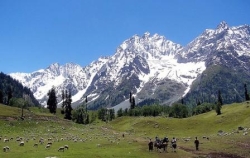
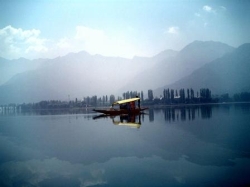
    Picture by Gautam Chatterjea : Kashmir meadows Picture by Gautam Chatterjea : Shikara lake side
    Picture by Gautam Chatterjea :
    Kashmir meadows
    Picture by Gautam Chatterjea :
    Shikara lake side

    I have been visiting the Himalayas untiringly all my life and my quest for more never ends, simply because surprises of Himalayan glory never ceases. Unlike the heritage locations in cities and towns around the world, where, after a short visit you could feel ‘I have seen enough of it’, the Himalayas would always spring up relentless attractions to keep the visitor thirsting for more. Exotic is the word that truly describes the Himalayas.

    To finish these musings…there is the story of a French woman Diane who fell in love with the charms of Himalayas and on her fourth holiday in the region, Sikkim this time around, she met a Bhutia youth whose politeness and way of life appeared so refreshingly different to her own. She was charmed by the man of Himalayas and romance blossomed soon enough. Knowing that the tradition and culture of the land allowed nuptial bonds only within the tribe, yet unable to accept the imminent parting on the conclusion of the tour, she enquired if he would accept her as his wife. He and his family gained the consensus of other villagers for their marriage and Diane became the Bhutia wife. And they lived happily in the glory of the White Mountains…

  • Write in (2)…On the way to Antarctica by Harold Dunn

    In a previous edition of the eNewsletter I asked if any of you had helpful tips, anecdotes or information on travelling to Antarctica…to help me investigate trip. Well Harold very promptly sent me this mine of information and I thought I’d share it with you all – maybe we can get something of a thread going here…

    Thanks very much Harold,

    The Ant

    I haven’t been to Antarctica, but I hung around Ushuaia for a week with a friend in middle or late November of ’06. We had heard that you could get last minute cruises for as little as half price if you went straight to Ushuaia. It was true! We were offered a $6000 cruise (11-days) for $3000. There are many companies and many different cruises. We had researched it all on the net beforehand and knew just what we wanted. Most cruises there were deeply discounted, but seldom down to half price. We wanted to see South Georgia Island, especially the spot where Shackleton landed his small boat before crossing the mountains to the whaling station. That particular cruise was discounted only 25%, so we decided not to go. Some cruises never step foot on Antarctica, just look at it from a distance, maybe land on an outlying island or two. Do you want to see penguins? If so, what kind, what species? We wanted to see the King Penguins, which would have to be another season, not November. Great penguin (another species) viewing on a short, inexpensive day trip out of Punta Arenas, Chile, which used to be the richest city in the world per capita. If you go there, see the Shackleton Bar in the best hotel on the central plaza. And see the rich man’s house a block away, now a museum. Don’t sign up for a trip to Torres del Paines Nat. Park from Punta Arenas. Take a bus to Puerto Natales, find your own hotel (starting around $10) and book a trip to the park from there, so you get a longer day in the mountains. Or rent a car for the day in P.N., but car rentals in Chile are double the cost in Argentina. Usually they won’t let you take a car across the border. A great cruise along the fiord west of Puerto Natales costs $50 for the day, but a better price can likely be negotiated at the dock the day before. The day includes a lunch stop at a working sheep ranch. Bring your own lunch and save a bundle, then use your lunch time for pictures of the abundant bird life and the sheep dogs. You’ll see two glaciers that come off the Southern Ice Cap. One reaches the sea, and you can get within a half kilometre. Bring rain gear. Icebergs on the sea. Torres del Paine is truly spectacular, but your chances of seeing the Torres are only about 10-20%, due to constant fog and overcast. We lucked out.

    Back to Ushuaia. I found a hostel for $10 a night. My friend opted for one at $60. Talking with the locals, the town is booming, with a 30% increase in tourists each year, so prices are going up fast, and the season keeps getting longer and longer. We thought we were early enough to beat most of the tourists, but before we left my hostel was full up and booked for the rest of the season. So do get a reservation. My place was the cheapest in the whole city (50,000), yet plenty adequate. Nothing lacking. I doubt anything in Ushuaia would be sub-par. The whole place is new. Almost nothing old or run-down. Place is cold and rainy most of the time. And windy, very windy. Take the ski lift to the top (about 2000′) and look for the pet “eagle” at the little cafe on top. He’s free to go, yet hangs around. Good pictures. Otherwise not much of interest in the area for me. It’s worth a day, no more, unless ya gotta stay, looking for deals to Antarctica.

    I’m not a member [of Globetrotters], but was for several years in the 1960’s. Write if you got Q’s.

    Harold Dunn

    San Diego, California

  • Write in (3)…Voluntourism Survey by Laura Outlam

    A request from Laura that might appeal to our well travelled members – can you help?

    I am a final year undergraduate student studying joint honours in Events Management and International Tourism Management at the University of Gloucestershire, UK, and I am currently focussing my dissertation on the niche area of voluntourism within the tourism industry. My dissertation researches voluntourism and the possible negative consequences it may have had on host communities since its increase in popularity in recent times. My study aims to provide recommendations to sending organisations on how they can ensure the continued welfare of host communities and environments, as well as educate their voluntourists adequately before departure. Since the proliferation of organisations sending tourists for their own financial gain, as well as tourists regularly going for their own personal pleasure (to satisfy their own emotional needs rather than the needs of the host community), I feel this is an important contemporary issue.

    To ensure I receive an adequate response from a wide range of voluntourists, I am researching adequate sources to distribute the questionnaire and I wondered if your members [/readers] would complete the survey? I have made the questionnaire available online through a link that can also be emailed to participants directly. Please find further details here:

    http://FreeOnlineSurveys.com/rendersurvey.asp?sid=ezuhyppzkz03hpf412979

    If you are able to help in any way it would be greatly appreciated, and I would be more than willing to share my research and findings with you once the study is complete.

    Thank you for your time, I look forward to hearing from you soon.

    Kind Regards

    Laura Oultram
    University of Gloucestershire

  • Write in (4)… Tick Alert by Andrew Barton

    A request from Andrew that might appeal to & help our well travelled members – can you help?

    Climate change is exposing more outdoor enthusiasts heading for activity holidays in Europe to a potentially fatal tick disease than ever, warn leading scientists. Higher temperatures and more rainfall across central Europe are creating perfect conditions for ticks to thrive in countryside areas, according to the ISW, a group of experts investigating Tick Borne Encephalitis (TBE).

    “It is believed that the life cycle of ticks will increase in the next few years, and as a result the geographical distribution of ticks will expand and population density will rise,” said Professor Jochen Süss of the ISW. Tick Alert, a campaign to raise awareness of tick disease has launched ‘Tick Watch 2008’ – the first-ever public survey about ticks in the UK and abroad – and is asking ramblers, campers and outdoor pursuits lovers to take part (visit www.masta.com/tickalert and click on the link). The survey aims to find out if ticks are spreading and becoming more common, if people have had problems with ticks on holidays in the UK or Europe and whether ticks are being spotted outside the main spring/summer tick season. A spokesperson from Tick Alert said: “We hope that by encouraging people to ‘think ticks’ when they are out and about in the countryside that they will be more aware of the potential disease risks from tick bites and take adequate precautions to protect against them.”

    The number of TBE cases requiring hospital treatment in Europe rose to 13,000 last year, a 30% increase on 2006. Every year in the UK up to 3,000 people suffer a tick infection and the Health Protection Agency reports that the number of laboratory-confirmed cases of Lyme disease in England and Wales almost trebled to 768 in 2006. Scotland alone has seen a tenfold increase in numbers over the last decade with 177 cases reported in 2006.

    Notes:

    • The Foreign Office advises that visitors to TBE endemic regions seek advice from their local surgery or clinic – well before travelling.

    • TBE endemic countries are: Albania, Austria, Belarus, Bosnia, Croatia, Czech Republic, Denmark, Estonia, Finland, France, Germany, Greece, Hungary, Italy, Latvia, Liechtenstein, Lithuania, Norway, Poland, Romania, Russia, Serbia, Slovakia, Slovenia, Sweden, Switzerland and Ukraine.

    • Lyme disease areas of the UK are: Exmoor, the New Forest, the South Downs, parts of Wiltshire and Berkshire, Thetford Forest, the Lake District, the Yorkshire Moors and the Scottish Highlands.

    • Ticks are found typically in rural and forest areas from late spring and throughout summer. At-risk groups include all visitors to rural areas of endemic countries, particularly those participating in outdoor activities such as trekking, hiking, climbing, cycling and camping.

  • Welcome to the April 2008 eNewsletter!!!

    Hello all,

    This month I thought I’d start off with a couple of different items and introduce you to two people who are professional travellers & who might be able to get you think about places you have experienced, near and far:-

    With the generosity of travel author David Stanley I can offer you a chance to win your own copy of the recently launched 8th edition of Moon Fiji – . All we ask you do is email me, theant@globetrotters.co.uk the most original & yet correct answer to the question What is yagona and when might it be used? I’d then like the winner to write a review of Moon Fiji that I can include in a future edition of the eNewsletter.

    Another promotion of a more local nature to Globetrotters! Artist Karen Neale and long term club member has her next exhibition in London organised…on 9th, 10, 11th of May she will be displaying a collection of her London landscapes across a number of formats – books, prints, paintings & cards. More details can be found on KarenÂ’s web site at http://www.karenneale.co.uk/. Feel free to pop along at anytime over that weekend and be supportive!!

    As you’ll see below this month’s edition features some of regular contributors and snippets of information but I’ve included articles from two new writing teams… Carol & Martin Noval who talk about trekking in Ladhak and Myrna & Gene Ginder who write about sailing at Christmas 2007 around Southern Africa. So if youre unsure about submitting your article, take inspiration from the guys and send your writing through…I’m sure weÂ’ll all be surprised by the results.

    That’s it for now…enjoy your eNewsletter and the lighter evenings of summer/daylight saving,

    The Ant


  • Meeting news from the London branch by Padmassana

    Our first speaker was GlobetrottersÂ’ third travel legacy winner Helen Barnhill, who recounted her trip to Nepal and Tibet, which was featured in the last issue of the Globe. Helen’s journey took her to Kathmandu where she had to arrange her onward transport to Lhasa. Helen showed us the sights of Lhasa including the Potala Palace, Norbulingka and the Barkor. Mount Kailash had been Helen’s dream and the legacy allowed her to fulfil this too as she completed the Kailash Kora. She came back via Everest base camp to the border town of Zhangmu and back to Nepal.

    Bronwen Riley was our second speaker, she showed us that despite the preconceived ideas many people have about Transylvania in Romania that the area has much to offer apart from Bran castle and Count Dracula. Bronwen showed us some of the lovely countryside, castle type churches where hams used to stored in the towers and which also included cells where warring couples would be locked up to settle their differences for a week at a time, they either lived happily ever after, or one had probably murdered the other! There used to be many people of German descent in this area, said to be where the children of Pied Piper of Hamelin fame ended up. After the Romanian revolution most of the German population left for Germany. Transylvania’s forests are also home to wolves and bears.

    London meetings are held at The Church of Scotland, Crown Court, behind the Fortune Theatre in Covent Garden at 2.30pm the first Saturday of each month, unless there is a UK public holiday that weekend. There is no London meeting in August, but we start afresh in September. For more information, you can contact the Globetrotters Info line on +44 (0) 20 8674 6229, or visit the website: www.globetrotters.co.uk.

    For details of the forth coming meetings of the London branch, April to July 2008 – http://www.globetrotters.co.uk/meetings/lon08it2.html.