If you have a travellers tale that your aching to tell.
Then why not visit the “Travel Sized Bites” section of the
Website and share it with the world. Travel Sized
Bites
Category: archive
-
The Maldives Tourist Info by Muaz Adnan
Scattered across the equator across the Indian Ocean, the pearl like
islands of the Maldives depicts the rare vision of a tropical
paradise. Palm fringed islands with sparkling white beaches.
Turquoise lagoons, clear warm waters and corals reefs teeming with
abundant varieties of marine fauna and flora, continue to fascinate
visitors as it has fascinated other in past, for thousand of years.
Marco Polo referred to the Maldives as the flower of the
Indies and Ibn Batuta referred to the Maldives as one of the
wonders of the world.Truly a natural wonder, the height of the islands rarely reach
above two metres. The 1,192 islands consist of 27 atoll formations,
spread over 90,000 square kilometres. The Maldive atolls are a
classic discovery in their own right: the word atoll is derived
from Dhivehi, the Maldivian language, from the word atholhu.The islands are surrounded by shallow crystal clear lagoon enclosed
by coral reefs. The unique islands provide visitors with one of the
most breath taking views of underwater life in the world. Formed
above peaks emerging from the depths of the ocean, upon layers of
both living and dead coral, and remnant of other marine life, the
islands are generally covered with dense tropical vegetation.
Coconut palms towering above dense shrubs and hardly plants
protecting the shores from erosion are natural features in most
islands. These islands together embody living entities in various
stage of formation. As interdependent elements in ecology, in a
food chain where birds, fish and other marine life co-exist, with
humans at its apex as caretakers for centuries.Measuring 820 kilometres north to south and 120 kilometres east to
west at its greatest width, the closest neighbours are India and
Sri Lanka. With a population 270,110 ( 2000 official estimate),
only 199 islands are inhabited 87 islands are set aside exclusively
for tourist resort development.There are plenty of things to do in the Maldives. You can take a
diving safari where you can visit inhabited islands (fishing
villages), resorts and uninhabited islands. Even if you are not a
diver, or a honeymooner, there are cultural shows, excursions to
Malé, night fishing, barbecues (subject to weather and length of
stay) to keep you entertained. It is possible to visit a local
inhabited island and see their simple life style in harmony with
nature also you will get the opportunity to see some of the typical
daily chores carried by the simple island forks while other maybe
involved in building a wooden local dhoni boat or weaving rope etc.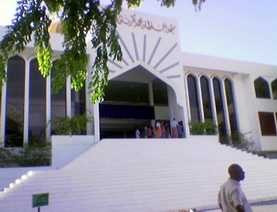
Sultan Mosque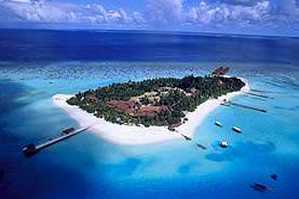
A typical resort, this one is the Laguna Beach ResortSome people like the big game fishing and night fishing where you
can usually go to an uninhabited island to have a barbecue after
the fishing.If you are interested in visiting the Maldives, Mr Muaz Adnan would
be only too happy to advise you and make any travel arrangements
and bookings for you. He can be contacted by e-mail on: muazadnan2002@yahoo.com
-
Interesting Facts
Interesting Facts
-
Aussies
picked up the most medals each at the
Sydney Olympics, which brings them into the
all time top 11. -
Finns are
perhaps the world's greatest athletes,
ranked first at summer Olympics and
third in winter games. - Almost half of Ecuador is protected.
-
Kenyan women
work 35% longer than their men folk.
-
Ethiopians
are by far the most agricultural people on earth (both men
and women) -
Looking for Czech and Slovak men?
Half are in factories. -
American
women have the most powerful
jobs. -
Southern European women hugely outnumber
their men folk amongst the unemployed. -
The top 8 most developed
countries all speak Germanic languages. Every such country is in
the top 20. -
Belgium is
the only country in the world where women dominate the
ministry.
Source: www.nationmaster.com
-
Aussies
-
A Little Part of Istanbul
When Sultan Mehmet the Conqueror took over Istanbul in 1453, he
first ordered the construction of a new palace for this new Ottoman
capital, on a site in the district of Beyazit where Istanbul
University stands today. Then he changed his mind and had a number
of buildings constructed on the headland which was an olive grove
to the southeast. It is these buildings that became the Topkapi
Palace. The Topkapi Palace was the home to all the Ottoman sultans
until the reign of Abdulmecid I (1839-1860), a period of nearly
four centuries. The final form of the first palace covered an area
700m², and was enclosed with fortified walls 1400 meters in length.
The walls had a number of gates, namely the Otluk gate, the Demir
gate and the Imperial Gate and a number of minor angled gates
between them. After the reign of Mehmet, the palace grew steadily
to form a city like complex of buildings and annexes, including a
shore palace known as the Topkapi shore palace, as it was situated
near the cannon gate -Topkapi- of the ancient walls of Istanbul.
When the shore palace was burned down in 1863, it lent its name to
the great complex we now know as Topkapi Palace.The Topkapi Palace continued to be the principal residence for four
centuries until in 1853, Sultan Abdul Mecid I moved into the new
palace of Dolmabahce on the Bosphorus. The old palace was used as
house for the women of the departed sultans and their servants
until the Harem was officially disbanded in 1909. In 1924, Topkapi
Palace was converted to a museum on instructions of Mustafa Kemal
Ataturk. The final step was the opening of the Harem to the public
in 1960.Because Topkapi is the first attraction to tick off on
everyone's list get there when it opens, so get there early.
The Topkapi Palace Museum is open between 9:00 am-5:00 pm everyday
except for Tuesdays. Tickets can be purchased in the gateway to the
Second Court. The tickets cost 12.000.000 TL. (equivalent to about
8 USD or 7 EUR) per person. The treasury section needs a separate
admission fee and costs 10.000.000 TL. There is a discounted fee
for the students. The Harem Section can be visited with a separate
ticket in the ticket office near the Harem entrance. The tours to
Harem are operated every half hour from 9:30 am to 4:00 pm. The
tickets cost 15.000.000 TL(11 USD or 9 EUR).Go straight to the Harem, which can only be seen by guided tour, as
the tours fill up early. After the Harem tour you can stroll around
the palace's grounds and the four courtyards at your leisure.
Also, don't miss the Treasury in the 3rd courtyard which houses
gold, and works of art.Straight after the Topkapi Palace, head for the Aya Sofia and the
Blue Mosque which are virtually next door.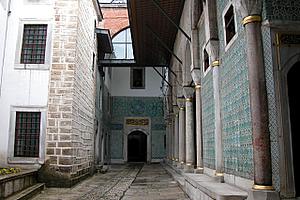
Courtyard of the Eunuchs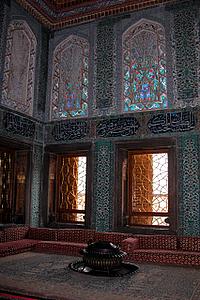
A room in the harem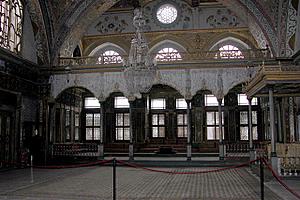
Topkapi Imperial Hall, Harem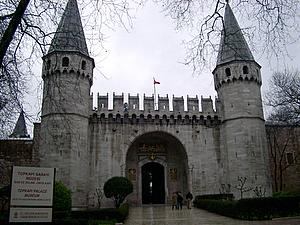
Topkapi Gate
-
Meeting News from London by Padmassana
This months meeting took place to the organ music from the
wedding taking place in the Church of Scotland upstairs. Our first
speaker was Tricia Hayne who gave us an interesting talk on
the Cayman Islands, which were first discovered by Columbus'
son and in 2003 celebrated their 300th anniversary. The
island's main income is due to its offshore financial
companies, but also tourism and it was obviously this area Tricia
spoke about. She showed us the local wildlife including the blue
Iguana and the Butterfly Farm. For the more energetic traveller
there is diving on the Cayman Trench and some rock climbing. Not to
mention the beautiful beaches.After the break Pamela Goodall told us about her cycle
adventure around the world with a tent! Her journey took her through Europe, she made it to
Germany before her first puncture, where another cyclist helped her
out. She had quite an adventure, being propositioned by a dodgy
hotel manager in Rawalpindi and “kidnapped” by a
shopkeeper for 4 days in India. After a crash on her bike she went
on “Good Morning India” with two black eyes that the
presenters didn't even bother to ask her about! Her trip
continued through Asia where she visited Vietnam and China where
strangers kept appearing to take care of her. She came home via
Mexico and the USA. Pamela's talk finished to the accompaniment
of Bach’s Toccata & Fugue (thanks to Globie Sarah D for
identifying that) as the wedding upstairs ended.Forthcoming London meetings:
Saturday 4th June – 2.30 pm – usual Crown Court location
John Gimlette will talk about his travels in Labrador and Newfoundland,
called a “Theatre of Fish” and Tim Mackintosh-Smith will
discuss his travels in India in a talk entitled “The Hall of a
Thousand Columns”.Saturday 2nd July – 3.00 pm NB – change of meeting place
and time
Concert Artistes Association, 20 Bedford Street, Covent Garden,
London WC2This is the last meeting before the August break, when we'll be
back in September. There will be an examination of Members Slides
comprising eight mini-presentations from Globetrotters members.London meetings are held at The Church of Scotland, Crown Court,
behind the Fortune Theatre in Covent Garden at 2.30pm the first
Saturday of each month. There is no London meeting in August, but
we will be back in September. For more information, you can contact
the Globetrotters Info line on +44 (0) 20 8674 6229, or visit the
website: www.globetrotters.co.uk