Vacation Dreams

Category: archive

  • Being Careful: Thailand

    This is the latest advice from the
    UK’s Foreign and Commonwealth Office
    on Thailand: there
    is a high threat from terrorism throughout Thailand,
    particularly in the far southern provinces of Pattani,
    Yala, Narathiwat and Songkhla. We recommend against all but
    essential travel to these four provinces where, since
    January 2004, there have been regular attacks including
    bombings and shootings. On 3 April, three bombs exploded in
    Songkhla Province, one at Hat Yai International Airport,
    one at a hotel and one in a shopping centre. Further
    attacks against places frequented by foreigners, including
    tourist resorts, could occur at any time.

    Watch out for crimes of opportunity. Theft of passports
    and credit cards is a problem. Passport fraud is high and
    penalties are severe.

    Penalties for possession, distribution or manufacture of
    drugs are severe and can include the death penalty.

    There has been an increase since January 2005 in the
    number of reported cases of Dengue Fever, in particular in
    Southern Thailand and the area near the border with
    Malaysia. In a very small number of cases, Dengue Fever can
    be fatal if left untreated. If you suffer from a fever
    whilst (or shortly after) visiting Thailand, you should
    consult a doctor.

  • Fave Website

    Spotted by Mac, a new travel website:
    http://www.travelpost.com/


  • London's Open House

    Every September the annual Open House London event takes place and
    this year the dates are 17th & 18th September 2005. Over 500
    buildings are opening their doors to everyone and turning the
    capital into a living architectural exhibition. And it's
    absolutely free! Last year, the Beetle and Padmassana braved the
    cold autumn air and set off to see if we could get to go inside the
    famous Gherkin – the tall, glass clad bullet shaped building. It
    could have been the early hour, or the lack of copious amounts of
    coffee, but coffee, we could see the gherkin but could we find it?
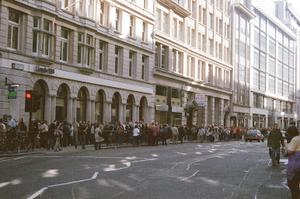
    It took an age to get there! By the time we got there, around 9.45am,
    the queues were breathtakingly long, as Padmassana's photos show.

     So, instead, we went to the Bank of England and we
    joined a guided tour there. It was excellent! Believe it or not,
    the site of the Bank of England, which has been located in
    Threadneedle Street since 1734, covers a massive 3 ½ acres – who
    would have thought it! We moved down a very majestic staircase
    to some beautiful state rooms downstairs and through the
    gardens and up again to the rooms that are used to hold meetings
    with visiting officials to discuss monetary policy. The tour ended
    in the Bank's museum which is fascinating and includes a gold
    bullion bar, encased in bullet proof glass, of course, which
    Padmassana had a go at lifting through the specially designed hole
    for people to touch the bar. You can visit the museum any time and
    it is free of charge. The museum is open Monday to Friday, 10.00 –
    17.00, Christmas Eve, 10.00 – 13.00 but is closed at weekends and
    on Public and Bank Holidays.

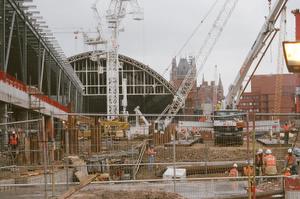
     After the Bank of England tour, we visited one of the
    livery companies near Smithfield market and after a fry up at the
    Beetle's favourite 24/7 greasy spoon café, we headed up to St
    Pancras and joined a tour run by Arups, the consulting engineers
    responsible for building the new ST Pancras train staton which is
    to be the new home of the Eurostar as well as a new and upgraded
    train station for regional trains.

    All photos are by Padmassana. We are looking forward to this
    year's Open House and maybe this time we'll be better
    organised to go and visit the Gherkin!

    If you'd like more information about this years' event,
    then take a look at the official website, which also runs other
    architectural tours during the year: https://www.openhouselondon.org.uk/


  • Exploding Toads

    Thousands of toads in an area of northern Germany are
    exploding. Seriously, this is not a late April Fool’s joke.
    Scientists do not yet know why the toads are exploding, but
    they are contracting some type of disease that causes their
    body to expand to three and a half times their normal body
    size – to bursting point. The BBC news report that the
    toads’ entrails are being propelled up to a metre (3.2ft),
    in scenes that have been likened to science fiction.


  • Know Your Riyals from Your Kwatcha

    Need to convert currency?

    Take a look at The
    Globetrotters Currency Converter
    – get the exchange
    rates for 164 currencies The
    Globetrotters Currency Cheat Sheet
    – create and print a
    currency converter table for your next trip.


  • Sounds of Mikindani by Tim Crouch

    Trade Aid is a UK based charity aimed at poverty alleviation in Southern Tanzania by creating educational and employment opportunities for the local community and assisting in the development of a sustainable tourist industry in Mikindani. As part of this, Trade Aid take on volunteers to work with the local community. Tim Crouch is one of these volunteers and her he writes about his experiences in the beautiful coastal town of Mikindani. For more information on the work that Trade carries out, see: http://www.tradeaiduk.org/

    As the sun sets over Mikindani, the smoke sits in the valley and
    the sounds rise; after another day in paradise I can't help
    thinking about the overload heaped upon my senses whilst in
    Tanzania. The sights can always be captured by camera and many of
    the most delicious smells can be recreated in the kitchen buts
    it's the sounds that make Mikindani so special and it's the
    noises that will stick most in the mind. Words can only scratch the
    surface of the overload Mikindani places upon the sense of hearing.

    The day always starts early in Mikindani and with it so do the
    sounds. At first light you hear the scraping, scratching noise of
    women sweeping, invariably just out side your door, a sound that
    rarely stops before it has accomplished its two aims of cleaning
    the street and waking Mikindani's inhabitants. Only after this
    sweeping has woken them up, do the cockerels start to crow. Being
    in Mikindani, you are never far away from some livestock, be it
    cows, goats or chicken and so you never feel far away from the
    farmyard. There is a theory circulating Trade Aid in Tanzania that
    animals in Tanzania are bred not for their meat (there can be none
    more gristly on earth) but for their capacity to break eardrums.

    The first real human voices come following the early morning school
    bell, a rock hit against the redundant rim of an old car wheel
    signifies the children's long and noisy walk up the hill to
    school. During the day office work is accompanied by the dulcet
    tones of the women next door calling their various kids for various
    reasons from various corners of Mikindani. When the children finish
    school in the afternoon, again accompanied by a ring of the school
    “bell”, the noise starts off as a distant cheer and
    culminates in a crescendo of young voices shouting their delight at
    returning home after a hard day in the classroom. This shouting
    just puts them in the mood for some more shouting when the games
    start during the afternoon, a din that doesn't stop until early
    evening when again the various mamas call their various offspring
    this time purely for the reason of feeding time.

    As you walk out to the road you are hit by the same diesel fumes
    encountered the world over but the amount of noise produced by such
    a tiny volume of traffic is a phenomenon unique to East Africa. The
    combination of decrepit engines and wildly elaborate horns produces
    a sound that will eclipse anything produced in a New York traffic
    jam.

    As we sit down to dinner the call to prayer from the mosque chimes
    in for the fourth and therefore penultimate time that day. After
    dinner we walk down the hill with the food for the dog, the fourth
    resident of the Trade Aid house to the sound of his whimpering at
    the smell of the leftovers we are carrying. Just as we lay in bed
    trying to get to sleep the women of Mikindani have one last blast
    this time to round up the men of the town before allowing all of us
    to slip off until the next day when the sensory overload will start
    all over again. I for one will miss it like crazy.


  • Great Wall of China

    Last year China’s first person in space disappointed the
    nation when he said he could not see the Great Wall of
    China from space. However, photographs taken from space
    appear to confirm that China’s Great Wall can be spotted by
    the naked eye after all. So China’s schoolchildren who are
    taught that the Great Wall is one of the only man-made
    structures you can see can breathe easy again.


  • So You Think You're Well Travelled?

    So You Think You’re Well Travelled?

    Here’s a little Beetle quiz based on capital cities. See
    how many you get right! Go on, have a guess!

    What is the capital city of the following countries:

    1. Chile
    2. Finland
    3. Kiribati
    4. Israel
    5. Comoros

    For the answers, see at the end of the eNewsletter.


  • Flag Quiz

    Which countries are represented by these flags? For the answers,
    see at the end of the eNews.

    1 2 3 4 5

  • Australian Spiders

    We’ve all heard horror stories about the deadly
    Australian funnel-web spiders. A new report in the Lancet
    shows that deaths from spider bites are extremely rare.
    Only 26 deaths from spiders have been recorded in Australia
    in the past century. In comparison, there were 1,183 motor
    vehicle deaths in 2001 in Australia.

    Funnel webs are only found in eastern Australia and
    there are at least 40 species. They are medium to large spiders, varying from 1-5
    cm body length. They like to burrow in moist, cool,
    sheltered habitats – under rocks, in and under rotting
    logs, crevices, rot and borer holes in rough-barked trees.
    In gardens, they prefer rockeries and dense shrubberies,
    and are rarely found in more open situations like
    lawns.