Meeting news from our branches around the world.
July’s London meeting took place on the other side of Covent
Garden at The Concert Artists Association, due to the building work
at our usual Church of Scotland venue. The September meeting will
also take place there, as the building work continues. The meeting
was an opportunity for 8 club members to take us on a digital
journey around the globe.
Kevin Brackley started the show with a trip through Iran and
Pakistan, we saw Tehran’s big square and the ex US Embassy
before taking in the beauty of the Esfahan mosques, the now
destroyed city of Bam and some interesting roads in Pakistan near
the border with Afghanistan where he tried his hand at firing an
AK47 Kalashnikov.
Sue Baker then took us east to Nepal, where she flew into
Lukla and then trekked to show us wonderful mountain Monasteries
and the Himalaya, including Mount Everest, staying in stone built
mountain huts along the way. Sue finished in Katmandu, home to
colourful Buddhist stupas and Pottery Square.
Sheila Nicholls showed us another high altitude destination,
Chile and the Atacama Desert, visiting San Pedro, the regions main
town, from where she saw brilliant red coloured volcanoes. The
Atacama region is also home to blinding white salt flats, places
making furniture from cactus wood and the spectacular El Tatio
geysers.
Raymond Martin brought us back across the Atlantic to
Romanian Danube delta. This corner of Europe squashed between the
Black Sea and Ukraine is not connected to the European road system
and as such is mainly only accessible by boat. No doubt it is
this inaccessibility that has contributed to it being a world
heritage area that is home to more than 300 types of wildlife. Ray
showed us the navigable rivers including the 1991 shipwreck of The
Vostock.
After the break it was Globies resident Aussie Jacqui
Trotter to take us down under for a trip she made with her Dad
from Darwin back to her home in New South Wales. Her trip was at
the start of the wet season which meant she saw water cascading
off Uluru and the Todd River in Alice Springs with water in! She
also showed us Katherine Gorge and The Devils Marbles, huge
roadside boulders in the middle of nowhere. Jacqui showed us the
now running again Ghan train snaking its way along before ending
back at the Blue Mountains in NSW.
Rosalie Bolland’s fascination with waterfalls took her
on an organised trip to see the Angel falls in Venezuela, we saw
the actual aircraft that Jimmy Angel crash landed on top of the
falls. Rosalie got some great views flying over the falls in a
light aircraft and the taking a boat to see them from closer up,
though the falls are so large she had difficulty getting them into
one photograph.
Neil Harris took us back to the sub continent to visit
Bangladesh, showing us that in fact it is not all just flooded as
out TV pictures seem to show us there is some higher ground there,
with markets and towns such as Cox’s Bazaar, where the people
were fascinated by seeing their picture on his digital camera.
Neil’s pictures showed us happy smiling people and some great
beaches.
Ernest Flesch transported us to Yemen in the Middle East, we
saw Palaces in the capital Sana’a, where the locals spend
their afternoons chewing qat. Out in the desert of wadi hadramat we
saw mud brick skyscrapers and mosques with red and white minarets
and not forgetting camels. The men all carried arms and knives,
which were on display in the shops, though don’t know how
Ernest managed to sneak those back into the UK!
Many thanks to all the members who made it a very enjoyable
afternoon.
By Padmassana
September’s meeting will take place on 3rd September at a
change to our usual venue:
Concert Artistes Association 20 Bedford Street Covent Garden
London WC2E 9HP Start 3.00 pm
Jules Stewart will be talking about “The North-West Frontier
and the Men who guard the Khyber Pass” Jules is a former
Reuter’s reporter – now freelance and author of ”
The Khyber Rifles: from the British Raj to Al
Queda” and now working on
a book about the Pundits.
After the break, Juliet Coombe will talk about “Sir-Lanka
post-Tsunami – In a crisis, EVERYONE counts !” Juliet is a
very busy freelance travel writer, photographer and publisher and
more. She cleared her desk and flew to Sri Lanka to work as a
volunteer with a charity group. A subsequent photographic
exhibition was a complete sell out, and will build a heap of
houses.
London meetings are held at The Church of Scotland, Crown
Court, behind the Fortune Theatre in Covent Garden at 2.30pm the
first Saturday of each month. There is no London meeting in August,
but we will be back in September. For more information, you can
contact the Globetrotters Info line on +44 (0) 20 8674 6229, or
visit the website: www.globetrotters.co.uk
We are sorry to say that for the time being, New York meetings are
suspended as Laurie really needs a helper. If you have some time to
spare and are based in or near NYC, please contact Laurie on the
e-mail address below.
For details of forthcoming meetings email newyork@globetrotters.co.uk
or register for email updates, click
here at our website.
New York meetings are held at The Wings Theatre, 154 Christopher
Street (btw Greenwich St and Washington St), to the right of Crunch
Fitness, in the Archive on the first Saturday of each month at 4
pm.
For information on Ontario meetings, please contact Svatka
Hermanek: shermanek@schulich.yorku.ca
or Bruce Weber: tel. 416-203-0911 or Paul Webb: tel. 416-694-8259.
Meetings are held on the third Friday of January, March, May,
September and November. Usually at the Woodsworth Co-op, Penthouse,
133, Wilton Street in downtown Toronto at 8.00 p.m.
Due to bereavement in Christina’s family, we regret to say that
Texas meetings have stopped pending further notice. If you have
time to spare and would like to take over Texas meetings, please
contact the Beetle on: beetle@globetrotters.co.uk
If you enjoy writing, enjoy travelling, why not write for the free
monthly Globetrotters e-newsletter! The Beetle would love to hear
from you: your travel stories, anecdotes, jokes, questions, hints
and tips, or your hometown or somewhere of special interest to you.
Over 8,000 people currently subscribe to the Globetrotter e-news.
To see your story in cyber print, e-mail the Beetle with your
travel experiences, hints and tips or questions up to 750 words,
together with a couple of sentences about yourself and a contact
e-mail address to Beetle@globetrotters.co.uk
When I told people I was going to Slovenia, the reactions I
got
were similar: “Where?” “What? Is that a
country?” “Hmm, never heard of it” and “What is
that near?” My mother asked if it was dangerous and my brother
simply laughed.
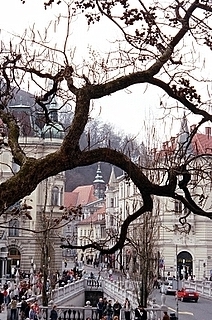 If
If
you don’t know where Slovenia is or you didn’t even know
it existed, you shouldn’t be ashamed. It is one of Europe’s
smallest countries with a population of less than 2 million. The
capital city, Ljubljana, has fewer than 300,000 inhabitants. It is
a “new” country in the sense that it has only existed as
its own nation since 1991, when it became the first republic to
separate from the former Federal People’s Republic of
Yugoslavia.
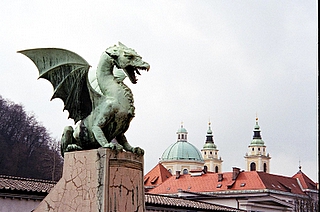 Slovenia
was fortunate in that it managed to gain independence
without suffering from the war and genocide that befell its
neighbours, Croatia and Bosnia. This is partially explained by the
fact that Slovenia is ethnically pure relative to its neighbours:
most people living in Slovenia are Slovene and Catholic. Further
east, there was a patchwork of ethnic and religious groups that
left no clear dividing lines.
After Slovenia’s plebiscite for independence yielded 88% in
favour of breaking from the Yugoslav federation, there was a brief
conflict with Belgrade dubbed the “Ten-Day War.” I asked
for details, but Nikolaj (one of the Slovenes I befriended) told me
it was not really a war. I wanted to know what it was like living
through the separation, but he told me there were only a few
skirmishes and less than 20 Slovenes died.
Nikolaj was extremely proud of his country and heritage. He
insisted that he was “patriotic, not nationalistic,”
although I began to doubt this assertion after he made a few
comments along the order of “Slovenes only leave Slovenia to
realize it is the best country and come back.” He was
convinced that Slovene wine was better than French wine. He told me
which of the songs playing at the bar were Serbian nationalistic
anthems and which ones were Slovene folk songs.
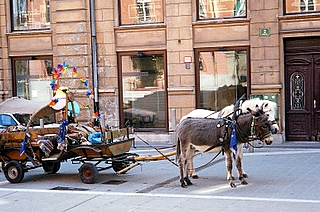 He
He
took me to a bar where there was a painting of Tito on the wall
and the bartender forgot to charge us for our Laskov beers. Nikolaj
insisted that I sample all of Slovenia’s drinks, including
beers from the two national breweries (Laskov and Union) and
several spirits distilled from blueberries and anise, whose names I
would mention except they are utterly impossible to pronounce,
spell, or even remember for that matter.
The beauty of the Slovene language is that it does not
restrict
itself with the requirement that words actually contain vowels.
Words comprised entirely of consonants (e.g. trg, vrt, smrt) are
fully acceptable, although Nikolaj tried to convince me that all
these words contain “silent vowels.” Other words contain
an unnaturally long string of consonants (e.g. odprto) or a
fundamentally disturbing combination of letters (e.g.
predvcerajsnjim).
I mean honestly. That looks like alphabet soup on crack.
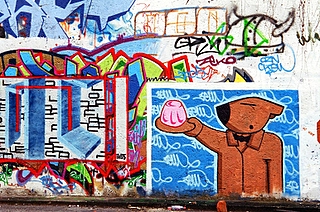 The
The
Slovenes are friendly people and many of them spoke to me. In
fact, they are extremely engaging, to the point that you oddly feel
at home in Slovenia and never want to leave Ljubljana. This is what
happened to Diego, an American who I met through Vladimir, a
Slovene bartender at my hostel. Diego came to Ljubljana and loved
it so much that he kept on coming back. Finally he just decided to
stay for good.
Diego and Vladomir took me to the nice bars in Ljubljana.
Considering the city’s small size, there are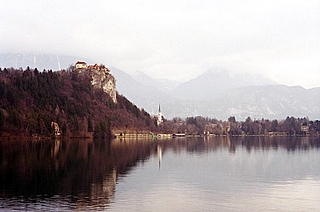
surprisingly many.
The hostel where I stayed (the Celica) is in the heart of the
city’s alternative scene. When I read about the hostel in the
Rough Guide, I was slightly alarmed because it mentioned the
building used to be a military prison. I went ahead and booked a
bed anyway because it was the cheapest place to stay. It turned out
to be more of a cultural centre than a hostel, with music
performances, art workshops, and a happening bar.
Outside of Ljubljana, the Slovene country is absolutely
gorgeous.
The scenery is stunning – lush, idyllic, and bucolic. Over half of
the country is covered in forest and 40% is mountainous. There are
alpine lakes crowned by cliff-top castles and island churches.
Slovenia is an easy place to fall in love with. It exceeded my
expectations and the only disappointing part about my visit was
that I had to leave Ljubljana. For now at least…
Trade Aid is a UK
registered charity, which works with and supports Trade Aid
Tanzania, a non profit-making Trust. Trade Aid supplies educational and material
resources, and also volunteers from Europe. Our aim is to alleviate
poverty in Southern Tanzania by creating educational and employment
opportunities for the local community and assisting in the
development of a sustainable tourist industry in Mikindani.
Below we describe a new seedling planting project we are helping
with in Mikindani.
 African Blackwood/African Ebony, Dalbergia Melanoxylon and African
Ironwood are all names for the tree that is locally known as
Mpingo. The uses of this tree are endless and for this reason
Mpingo is now one of Africa’s most endangered trees. Our
advisor, Mr Thomas knows all too well the importance of protecting
our natural resources and therefore Blackwood is his choice of seed
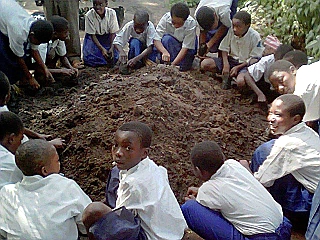
for this season’s project in the tree nursery. The children
(see picture below) from Singino and Mnaida Schools have started
the seedling trays which will be potted into plastic pods in a few
weeks. By the Autumn the saplings will be distributed around the
schools in Mikindani for the next tree growing project.
 Conserving trees such as Blackwood is an essential practice if we
are to benefit from its many uses:
- Beehives- the tree is used as a hive. The honey produced is dark
amber and strong flavoured.
- Building materials- it is an extremely durable wood, also ant and
beetle proof.
- Fuel- the heat generated from Mpingo fires is so high that it can
melt cooking utensils.
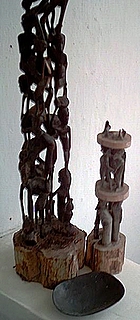
- Crafts- nearly all Makonde carvings will be designed out of this
wood.
- Domestic use- clubs, hammers, spears, sticks, chess pieces
- Dye
- Fodder- the pods and leaves are used as animal fodder
- Land improvement
(green manure, mulch and nitrogen fixing)
- Medicine- the roots are used to treat abdominal pain, diarrhoea
and syphilis. The wood smoke is inhaled to treat headaches and
bronchitis.
- Musical instruments- piano keys, clarinets
‘By wise planning now we can insure that this valuable natural
resource will maintain its vital role in the local ecosystem and be
available for the future harvesting of mature trees for woodwork
purposes.’
Back in January 2004 Martin Wright, one the club’s most
sociable regulars at the London Meetings, royally entertained a
packed Crown Court with tales of his marathon cycle ride to
Australia. Many in that audience will remember his great photos,
distinctive narrative style and his thirst for adventure. Well
Martin is at it again – this time he’s go back to the land down
under to ‘pick up his bike and have a look round’. I think
too many cold winter nights provided the motivation to get back on
the road! This is the fourth in an occasional series, based on
Martin’s emails, and charts his offbeat approach to the road
ahead.
5 May: Hi all. Have made it as far as Ayutthaya, 60 kms
north of Bangkok. Previously I had spent a few days in Kanchanaburi
– 120kms west of Bangkok and infamous because of the death railway
and the bridge over the River Kwai. In the meantime I took a train
to Bangkok to apply for a new passport as the old one was full. At
the British Embassy, a huge building in a compound which seemed to
take up half of Bangkok, I was given the necessary form to fill in
and then had to part with almost 70 pounds sterling! Also had to
wait five working days, which because of the bank holiday turned
out to be six. If the buggers back in the U K had given me a 48
page passport which I paid for when I last applied I would have
saved myself time and money.
While in Bangkok I stayed in a hotel in Chinatown overlooking the
river – very nice, quiet and at night there was a cool breeze.
During the daytime it was sweltering and I’ve found that it is
much easier to cycle than walk in this heat. This all made a great
change from the Khao San Road area which resembled a zoo although
none of the animals are on the endangered list!
Chinatown was a great area for wandering around especially at night
when the food stalls were operating. Found an eating place next to
a Chinese temple where the food was delicious and the beer cheap –
ate here three nights in a row and met the same people. One fellow
was the local drunk who always had something to say, although I
understood nothing I am sure he thought otherwise.
On Monday I left Kanchanaburi and cycled through Suphan Buri on to
Ayutthaya where I arrived on Tuesday. Wednesday saw me back on the
train to Bangkok to collect my new passport followed by a visit to
the immigration department, which of course was some distance away
to have my entry stamp put into my new passport. Back on the sky
train, back on a boat, back on the train and back to
Ayutthaya…glad to have this finished.
This morning I decided to make coffee in my room on my Trangia
stove…not a good idea as it turned out. A Trangia burns
methylated spirits and while I put the water on to boil I hung my
washing out to dry. This took longer than expected, and when I
returned the bedside cabinet was on fire! A bottle of water put out
the flames and of course made a horrible mess – a clean up
operation was in order and hopefully I have left no trace of my
attempted arson. I still had enough water in the pan to make a cup
of coffee thankfully. I am going to throw that Trangia away as it
is the first time I have used it since leaving Australia, and it is
bulky & heavy. Anyway the coffee from the hawkers is far better
stuff! Am heading towards Cambodia where I should arrive in about
one week…hopefully I will arrive without having burned down
somebody’s guest house!
9 May: On leaving Ayutthaya my intention was to cycle
in an easterly direction towards Cambodia but as I arrived at the
relevant junction I was offered the choice; turn right for Cambodia
or go straight ahead and visit northern Thailand! As I had not
visited the north before I thought, ‘bollocks to Cambodia for
now I like the look of the road on the map which runs along the
border with Myanmar.’ It does present me with a slight problem
as I will have to find a crossing point into Myanmar for a five
minute, one hour or one day visit but on re-entering Thailand I
will be given another 30 day stamp! This should give me plenty of
time to reach Chiang Rai in the north before following the Mekong
all the way back down to the Cambodian border.
At present I am in Sukhothai staying in a very quiet and peaceful
guest house next to a river. My intention was to spend two nights
here with one day for resting, however I will now be having at
least three nights and two days here as I would like to ride out to
old Sukhothai to visit the very old capital city. There are of
course many good eating places; night markets and small restaurants
where the food is of course brilliant and cheaper than chips! As
yesterday I cycled further than I normally would in a single day,
it was cool and I had a tail wind, I thought I might as well make
the most of it, as it is the first day in Asia when the temperature
did not reach 30c. It was a very cool and pleasant 29c. Soon after
I reached the guest house a strange thing happened – it
rained…not the English rain whereby it takes all day for one
millimetre to fall. This was good old tropical rain and after one
hour of rainfall the roads are like rivers. Soon after the sun
comes out and within a short time it is blue sky and no sign of any
rainfall.
On that note good bye to you all and have a nice day. Martin
Trip duration: 11 days
Trip miles to date: 2,017
Miles since last update: 2,017
 As
As
I’m writing this I’m drinking an extremely strong coffee in
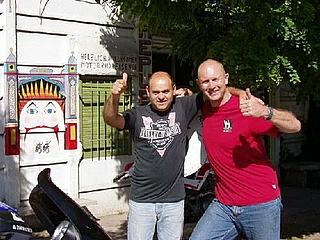
Rio Gallegos (no, I’d never heard of it neither), about 1,750
miles south of Buenos Aires and about 300 from Ushuaia. This is me,
on the right of the picture.
These first few days in the saddle have been a gentle introduction,
I think. The southern Argentinean roads have been unbelievably
straight, set within a dead-flat terrain with strong winds and
little traffic. The sense of distance (from home as much as Buenos
Aires) has accumulated every day.
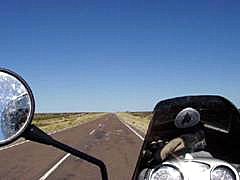 First stop-over was
courtesy of a tip from a fellow traveller (thanks Mick!) in Azul ,
235 miles from Buenos Aires. The thermometer on the handlebars
suggested 34 deg, verified by the perfect blue sky. I tried out the
‘helmet-cam’ on the way out of BA but I fear I’ve
accidentally recorded over the footage……oh well, I was riding
like a dork anyway.
I pulled into Azul about 5.30pm, and began searching the streets
for a garage with an 8ft painted BMW sign, coupled with an 8ft
Yamaha sign. I had no right to find it but these things have a
habit of working out and sure enough, along a quite residential
street I found “La Posta Del Viajero en Moto”….a mecca
to adventure motorcyclists and charitably run by Jorge, his partner
Monica and chief translator, daughter Polly. A
“donation-box” exists on the wall, but no mention was
made and I was left to discover it for myself.
I’m almost sad I found Jorge and his family at the start of the
trip, as I fear I won’t enjoy such a genuine and warm welcome
anywhere from here to Alaska. I turn up unannounced at 5.30pm on a
Wednesday and greeted with excitement, interest and treated to an
amazing asado (meat feast!) with the family. The bunk-house is
covered in graffiti from previous residents and the visitor’s
books (there are 3, and counting!) and all stuffed with the same
sentiment. I feel honoured to have left my mark and signed
“Brits Corner”…..
The next couple of days were spent speeding down to Viedma (pretty
coastal resort town), then Commodora Rivadavia where I stopped an
extra day to cruise around the Peninsula Valdès – a huge national
park and home to several thousand elephant seals and penguins.
Whale watching tours are popular here too.
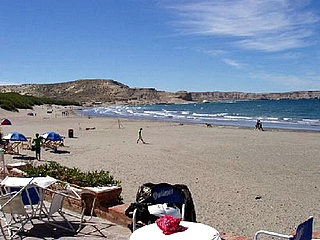
The Argentineans are extremely friendly. I stopped for a coffee in
Puerto Piràmede – see the picture left, and a chap excitedly
introduced himself as Ernesto Scotti. It transpires his son is a
fellow R-T-W bike and is in the Guinness Book of Records for a
related record. We chat and gossip for a long time and it’s
refreshing to be reminded that we are all basically the same,
“citizens of the world” as Ernesto described it much
better than I.
Yesterday I completed the biggest day in the saddle, about 500
miles down to Rio Gallegos. The terrain has changed subtly, and the
sense of remoteness increased, but this is no third world region.
The standard of living is still pretty high, especially
anticipating what is to come in Bolivia and Peru.
The bike is running great. I’m slightly concerned with the
speed of wear on the front sprocket and the rear tyre is also
wearing quickly. I think both of these symptoms are a consequence
of the extra weight the bike is carrying. Naturally I’ve packed
too much crap and will shred as I go.
One last note – as I parked up last night in the secure hotel
car-park I was pleasantly surprised to find another travellers bike
with a Brit number plate. It belongs to Jeremy Bullard (http://www.fowb.co.uk/)
who I believe is taking a break back in Blighty…..
Oh well, tomorrow I strike for Ushuaia and the end of the world.
If you want to know more about Greg’s travels: http://www.unbeatentrack.com/
Comprising of around 50 islands (750 if you count the archipelago
of the Bahamas), the Caribbean is a real treasure trove when it
comes to cruising. A rich variety of vistas, people and places
await, along with swaying palms and idyllic beaches of golden sand.
The network of islands in the Caribbean is in fact so extensive
that it is possible to book several Caribbean cruises and avoid
going to the same islands twice!
There are four basic Caribbean cruise routes used by cruise
operators:
- Western Caribbean Cruise Route – Departing from
seaports in Texas, Louisiana and Florida, the Western Route takes
in the Yucatan Peninsula of Mexico, the island of Cozumel, the
Cayman Islands, Jamaica, and any number of islands off the coasts
of Honduras and Belize.
- Eastern Caribbean Cruise Route – One of the most
popular Caribbean cruise routes, the Eastern Route typically
departs from Florida and other seaports along the eastern seaboard of the United
States. The route calls on destinations such as Key West, The
Bahamas, Turks and Caicos Islands the Virgin Islands (including
St. Thomas and St. Croix), and Puerto Rico.
- Southern Caribbean Cruise Route – This route
normally commences at San Juan in Puerto Rico, and takes in many
possible destinations along the Lesser Antilles and the
Netherlands Antilles as far west as Aruba.
- Exotic/Long-duration Caribbean Cruise Route –
This route takes in any/all of the above destinations, and can
sometimes end in a different place to where the cruise started.
Given this broad assortment of destinations available in the
Caribbean, it can be a bit overwhelming when trying to make that
crucial decision on which islands to fit into your itinerary. After
all, you don’t want to miss out on some true Caribbean gems, do
you? So, whether you’re planning a short vacation or a longer
cruise break away from home, here is a selection of
‘must-sees’ & ‘must-dos’ on your Caribbean
adventure.
- St Croix (Virgin Islands) – Take a night kayak trip in
Salt River National Park and visit the first landing site of
Christopher Columbus on his voyage to the New World.
- Grenada– Although ravaged by Hurricane Ivan in 2004,
Grenada is still well worth a visit for its scuba diving. You can
explore the largest shipwreck in the Caribbean here and see an
underwater volcano.
- Virgin Islands – The Cinnamon Bay National Park offers
excellent snorkelling opportunities. You can see a wealth of
underwater life in the shallow waters around St. Thomas.
- Jamaica – Why not try your hand at bamboo rafting in
Montego Bay?
- Puerto Rico – No Caribbean cruise would be complete
without a visit to the world famous Condado Beach on the island
of Puerto Rico.
- Aruba – Want to find Caribbean paradise? How about
relaxing on one of the 365 beaches that surround the Dutch island
of Aruba.
- St Kitts – Swim with the turtles in the waters around St
Kitts and then relax on the pink sand beaches on this beautiful
island.
Good luck with planning your trip and happy cruising. Metty
Metcalfe is the webmaster for A to Z Cruises which is the No1
resource for Caribbean Cruise related Information on the Internet.
Be sure to visit his site here:
The Royal Geographical Society (with IBG), in partnership with BBC
Radio 4, offer you the chance to make that journey and to tell the
world about it in a memorable piece of radio documentary-making. Each year the RGS-IBG and the
BBC award the best idea for an original, exciting, and exceptional
journey and we’re inviting you to join the great travellers
who’ve already fulfilled their dreams. It’s important that
the project takes you somewhere fresh, different and original – not
just a holiday to the Greek Islands! It’s also a good idea to
bear in mind where the five previous winners have been (such as
Ladakh in 2005 and Madagascar in 2004) as we won’t award
similar journeys this year. More details on the RGS-IBG website.
Your journey needs really to matter to you: we need to feel your
passion and enthusiasm and Radio 4 listeners need to be fascinated.
Bear in mind that the BBC already broadcasts a lot of documentaries
about faraway places (listen to Crossing Continents and From Our Own Correspondent, for example, in
order to gauge the style of Radio 4’s regular foreign
reportage). When thinking up your idea, make sure it’s the sort
of thing journalists rarely have the time to cover. Most reporters
can only afford the time and money to make short visits to meet
important people and don’t often get under the skin of local
society.
The programme you’ll be making needs to tell your story – and
that of the journey and the place you’ll be visiting (the
tourist trail isn’t likely to be top of the judging panel’s
list unless you can put an interesting new spin on it) – in a
graphic and attractive way. Think of the audio potential in the
idea – not just indigenous music and sounds (in reality they rarely
sustain more than a few seconds), but how you are going to find
interesting sounds within the substance of the journey (by keeping
an audio-diary, for example). Radio is very good on atmospherics
and imaginative pictures, but you need to think about what your
journey and your destination offer to create those pictures.
Conditions
- You’ll be travelling between January and July 2006.* We welcome travellers of all ages, but you must be able to travel safely and responsibly.
- You must have a permanent UK postal address.* Interviews will be held in early December in London. You must be able to attend these interviews in person.* Applications from small teams rather than solo travellers are also accepted, but please make clear in your application if this is the case.
- The award is for independent travel. We will NOT consider any journey joining a commercial expedition or pre-paid tour, including organised charity fundraising tours.
- The final deadline for pitches is Tuesday, 27 September 2005.
Please send your pitches, either by email or by post, to:
The Grants Officer, Royal Geographical Society (with IBG)
Email: grants@rgs.org
Address: 1 Kensington Gore, London SW7 2AR
Tel: 020 7591 3073
Full details are at http://www.rgs.org/category.php?Page=maingrants
Did you know, you can change the format of this
e-newsletter? This e-newsletter is available in 5 formats:
1. This format with 2 columns.
2. A single column print friendly version available
online, see the link in every e-newsletter (or
click here).
3. The text only version, if you’d like your
e-newsletter in plain text format, just send a blank email to The
Globetrotters Webmaster with “Text+Enews”
as the subject
4. Have a link emailed to you pointing to the online
version, just send a blank email to The
Globetrotters Webmaster with “Link+Enews”
as the subject
5. Subscribe to our full text RSS feed RSS
 We
We
are sorry to say that Mac is not very well, but he is still
e-mailing strong and recently sent the Beetle a collection of
travel reminiscences. This, and next month is about China.
One of the times I went to China I did not hide my military
connection but someone along the way before I left the states
changed my category from retired military to “teacher”. I
was travelling with an American woman who was actually a teacher in
the Military Dependent Schools in Korea. She told me she taught
Home Economics, health and sewing. When I was asked what I taught
my mind went blank and then I recalled what she taught and I said:
Home Economics, heath and sewing. My real teacher travel companion
was asked her what she taught. She smiled and said: football,
soccer, and wrestling. We were by then both laughing and the
immigration inspector shook his head at us and left us.
Before we got on plane for China we were told to turn over any
U.S. Military identification we had on us and to not take it into
China. I hesitated to do this in case it could be reproduced and
didn’t like giving it to someone I did not know, but had to
make a decision in a hurry and nothing was going to stop me from
seeing the Great Wall Of China. Someone later asked me if I had
walked the whole distance of the Wall. (It is 4000 miles long!) It
is wide enough for five horses (some say six as that is a lucky
number in China) to pass and is 2000 years old.
In Hangchow, Mr Wu showed us a painting on the wall of at
temple
for famous Chinese General Yue Eeti as a young man. The painting
showed his mother with a knife carving on the lads’ back the
admonition in Chinese letters: “Always be true to your
country.” Juanita, my friend, whispered to me: “That must
have made a lasting impression” Ha!
We went to the Sick Duck restaurant in Beijing. It is called
Sick
Duck because it is near a hospital. There is also a Super Duck
Restaurant, a Baby Duck restaurant and a Ruptured Duck Restaurant
(I just threw that in!) all serving Peking Duck (Beijing Duck does
not sound right.) The cook brings out the duck on a platter and
then you applaud. I don’t know if you are applauding the dead
duck, the cook or who.
Eunuchs (and there were 70,000 of them) at the time of the
Ming
destiny who allegedly carried their testicles about with them in a
little pouch in the hope of being reunited with them in death. (You
heard it here!)
When we got off plane in Hangchow a guide came up to us and
asked
“Are you the group of six?” We were the six that had
gotten our tour thorough USO in Seoul, Korea. When I told them I
did not have enough money with me to make the trip they said I
could write a cheque. He put us in a van and we drove into town.
When we saw a bicycle rider carrying a huge white wreath we asked
what is that. He said: “It is for warning”. He then
changed it to: “It is for mourning.” Mr Wu said he had
put on his “wish list” to return to Hangchow as a guide
(they had him working all over China) as he had a three year old
son in Hangchow. He said his son was born early in the morning so
they named him Xu Chiao Ming which means “The cock that crows
early in the morning.”
Our guide Miss Cha was late in getting to the airport at
Beijing.
She had gone to the wrong airport. She breathlessly rushed up to us
and apologized and said, “It is a slow boat to China.”
She then said, “If you do not understand my English you can
lump it.” We quickly realized she had memorized phrases she
did not know the exact meaning to. She was a nurse but they needed
guides badly so she had been assigned us. She asked who was from
Great Britain and said, “I hope I warm the cockles of your
heart.” We grew fond of Miss Cha and a friend, Lisa gave her a present.
She asked if she should unwrap it and Lisa said yes. She started to
unwrap it and her face turned red and she quickly rewrapped it. It
was a pair of silk stockings. When we went to leave Beijing we
asked Miss Cha if she would have breakfast with us in the foreign
only dining room. She said ,”No, I have other fish to
fly.” We warmed to all our guides except on those that tried
to feed us propaganda.
Kneehow (phonetic) in Chinese means hello. In China, Carol who
was
from England, and had a beautiful voice would sing slightly
risqué
Cockney songs and George would sing “My old lady and the lady
next door went down the river on a barnyard door singing Ki Yi
Yippie Yi ” and nonsensical songs. Miss Cha who was trying to
learn English (she had taught herself) wanted to learn some of
these songs so she could sing them to her next tour group. As some
were risqué Carol said, “My dear I don’t think you really
need to learn these songs.” Les would give his excellent
imitation of Peter Sellers imitating an Indian and his accent was
hilariously correct. We should have been a USO troop. We laughed
all the way across China.
In response to last month’s article about Diego Garcia, Mac
reports that a friend who was in the Seabees building airstrip on
island of Diego Garcia has just shown me an old yellowed newspaper
account of it dated June 25 1978. This is probably more than you want to know about this
isolated
island. 700 Seabees were sent there to built the airstrip.
A Portuguese armada sailing around the tip of Africa in 1512
stopped here. Settled first by French in the late 1770s the island
was occupied alternately by France and England following the
American Revolution. The survivors of the sailing ship Atlas which
was wrecked here on May 30 1786 joined the British expedition
settled on the island at that time. Slavery was introduced the
following year.
In 1787 a businessman from Mauritius saw opportunity on Diego
Garcia in the form of coconut oil lacking but needed by Mauritius
located 1,l00 miles southeast of Diego Garcia. He received
permission to harvest and export Diego Garcia coconuts to
Mauritius. Slaves were sent to pick them. A band of lepers
accompanied the slaves because it was felt that conditions on the
island might be healing to persons suffering from the disease. (By
1824 however, a government report said this was no longer believed
true.)
Emancipation was proclaimed in mid 1830s in all British
possessions. Former slaves were reported by one visitor to have far
better living conditions than on other islands. Island was later
used as a coaling station for ships. Coal shipped to the island.
When the Japanese invaded Ceylon off the coast of India in
1942
during World War II the Allies set up an outpost on Diego Garcia to
monitor Japanese activity. In the 1950s both England and United
States were concerned about Soviet activity in the Indian ocean where
“over one half of
the world’s sea borne oil is
in transit at any given moment according to a Congressional
hearing.“
There was a photo stating Donkeys introduced to Diego Garcia
about
1835 when the islands slaves were emancipated today roam freely
over most of the island (I am afraid I have passed on to you more
than you want to know about Diego Garcia. Ha. Information is from Sun
Herald Daily Living,
Gulfport Mississippi (where Seabees had their headquarters) Sunday
morning June 25 1978.
Beside the Seabee (branch of Navy that builds and does
construction.) I have received an e mail from a different retired
Navy man living in Italy. He says the highest point on Diego Garcia
was only about five feet high and during the Tsunami he wondered
how island fared but said he saw nothing in the news.
If you would like to contact Mac, he can be e-mailed on:
macsan400@yahoo.com
Ryanair’s chief executive, Michael O’Leary has threatened a
U.K. based Web site with legal action if it doesn’t take down
comments pertaining to Ryanair’s pilots. O’Leary described
by one commentator as one of the most combative CEOs to ever run a
public company, has launched abuse-ridden tirades against critics,
airports, competitors and regulators. In July, he called the
company that runs Stansted airport outside London a “bunch of
overcharging rapists.”
Back in January, O’Leary labelled a
European Union ruling that one of Ryanair’s airport deals was
anticompetitive as “Stalinist”. Despite his ability and willingness to dish out
ranting tirades against other people and organisations, he
doesn’t seem to take kindly to any criticism aimed at him. When
the Professional Pilots Rumour Network, PPruNe a Web forum popular
with Europe-based pilots, posted a discussion thread containing a
mixture of informed insights and um….interesting comments on
Ryanair’s relations with its pilots, the company’s lawyers
sent the Web site a letter demanding that it take down the thread.
The letter argued that the statements on the thread were
“untrue, unfounded, malicious and deeply damaging to the good
name and trading reputation of Ryanair.” The letter added that
Ryanair would move to gain an “immediate injunction”
against PPruNe and claim damages if the Web site didn’t remove
the thread, which discussed pilot unionization and pilot pay major
issues for Ryanair. PPruNe removed the thread, but a new thread has
appeared on the Web site concerning unionization at Ryanair.
Ryanair didn’t immediately comment when asked why it acted to
remove the thread. PPruNe owner Danny Fyne said: “Tactics like
this never work in the long term. If we didn’t publish it,
someone else would.”
To find other ways of increasing its revenue, Ryanair has been
doing all it can to cut costs and boost revenue. This has included
a cost-cutting move of the fitting of non-reclining seats. But one
move that is generating criticism, both among customers and in the
market, is a wheelchair levy on every ticket that Ryanair said it
was charging to cover the cost of transporting disabled passengers
to and from its planes. The levy appears to still be in place and
though it’s not clear if it is around 70 euro cents or 50 euro
cents, but if it is the lower number, the levy accounted for around
22% of the increase in operating profits at Ryanair in its June
quarter, compared with the year-ago period.
Some commentators say that the wheelchair levy is a clear sign of
desperation, but so are moves to cut the most basic of pilots’
perks. One measure has Ryanair pilots buying their own uniforms.
Ryanair management is currently trying to prevent pilots from
opting for their union to represent them in pay negotiations. In a
recent memo, a Ryanair manager at Stansted airport said that paying
union dues would amount to a waste of money: “If you want to
waste 1,000 pounds we recommend fast women, slow horses or even
greyhound racing. At least you’ll have a few minutes of
fun,” the memo said.
Experienced pilots who need to receive expensive top-up training to
fly Ryanair’s new series of Boeings have been told that the
company won’t pay for their training if they opt for union
representation, according to a person familiar with employee
relations at Ryanair.
If you have enjoyed reading this e-newsletter, why not visit the
Globetrotter website, http://www.globetrotters.co.uk/
and have a look at a copy of Globe, the bi-monthly printed
newsletter sent to members only.
We also send members only a listing of all members, their contact
details and countries visited and any help they can offer.
Globetrotter members network by using this listing to contact each
other in over 27 countries around the world to ask for travel
advice, and possibly even meeting. As a member, you will receive a
reduction on any Globetrotter meetings in your area, and will
entitle you to have free Globetrotter calling cards to give your
details to other travellers you meet while travelling.
Just US $29 or €24 buys you membership for one year. Contact
membership@globetrotters.co.uk
for more information.
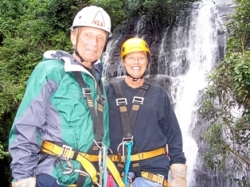
 Mac is still not very well but is still e-mailing strong. In this month’s Globetrotter e-newsletter, he writes about American Samoa, his friend Frank adds some of his reminiscences about British Samoa and other random thoughts on travels that we love to hear about.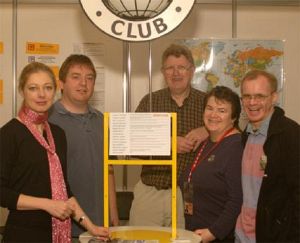
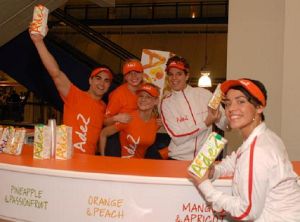 Guys and girls from Adez fruit juice kept us supplied with cold juice which made up for the fact that food and drink is so expensive at the show. As is the custom with the Globetrotters Club, after the event in the evening, Matt our chair, guided us to a fine pub behind Olympia, without the aid of GPS and a compass – later I rolled off my bus outside my flat and thought a good night was had by all.
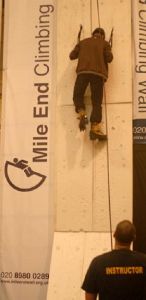 every place you could wish to visit.
  more visitor participant companies in next year’s show, and that they will start to plan for this, as this year’s show ends.


