Need to convert currency?
Take a look at The
Globetrotters Currency Converter – get the exchange
rates for 164 currencies The
Globetrotters Currency Cheat Sheet – create and print a
currency converter table for your next trip.
Trade Aid is a UK based charity aimed at poverty alleviation in Southern Tanzania by creating educational and employment opportunities for the local community and assisting in the development of a sustainable tourist industry in Mikindani. As part of this, Trade Aid take on volunteers to work with the local community. Tim Crouch is one of these volunteers and her he writes about his experiences in the beautiful coastal town of Mikindani. For more information on the work that Trade carries out, see: http://www.tradeaiduk.org/
As the sun sets over Mikindani, the smoke sits in the valley and
the sounds rise; after another day in paradise I can't help
thinking about the overload heaped upon my senses whilst in
Tanzania. The sights can always be captured by camera and many of
the most delicious smells can be recreated in the kitchen buts
it's the sounds that make Mikindani so special and it's the
noises that will stick most in the mind. Words can only scratch the
surface of the overload Mikindani places upon the sense of hearing.
The day always starts early in Mikindani and with it so do the
sounds. At first light you hear the scraping, scratching noise of
women sweeping, invariably just out side your door, a sound that
rarely stops before it has accomplished its two aims of cleaning
the street and waking Mikindani's inhabitants. Only after this
sweeping has woken them up, do the cockerels start to crow. Being
in Mikindani, you are never far away from some livestock, be it
cows, goats or chicken and so you never feel far away from the
farmyard. There is a theory circulating Trade Aid in Tanzania that
animals in Tanzania are bred not for their meat (there can be none
more gristly on earth) but for their capacity to break eardrums.
The first real human voices come following the early morning school
bell, a rock hit against the redundant rim of an old car wheel
signifies the children's long and noisy walk up the hill to
school. During the day office work is accompanied by the dulcet
tones of the women next door calling their various kids for various
reasons from various corners of Mikindani. When the children finish
school in the afternoon, again accompanied by a ring of the school
“bell”, the noise starts off as a distant cheer and
culminates in a crescendo of young voices shouting their delight at
returning home after a hard day in the classroom. This shouting
just puts them in the mood for some more shouting when the games
start during the afternoon, a din that doesn't stop until early
evening when again the various mamas call their various offspring
this time purely for the reason of feeding time.
As you walk out to the road you are hit by the same diesel fumes
encountered the world over but the amount of noise produced by such
a tiny volume of traffic is a phenomenon unique to East Africa. The
combination of decrepit engines and wildly elaborate horns produces
a sound that will eclipse anything produced in a New York traffic
jam.
As we sit down to dinner the call to prayer from the mosque chimes
in for the fourth and therefore penultimate time that day. After
dinner we walk down the hill with the food for the dog, the fourth
resident of the Trade Aid house to the sound of his whimpering at
the smell of the leftovers we are carrying. Just as we lay in bed
trying to get to sleep the women of Mikindani have one last blast
this time to round up the men of the town before allowing all of us
to slip off until the next day when the sensory overload will start
all over again. I for one will miss it like crazy.
Which countries are represented by these flags? For the answers,
see at the end of the eNews.

|

|

|

|

|
| 1 | 2 | 3 | 4 | 5 |
|---|
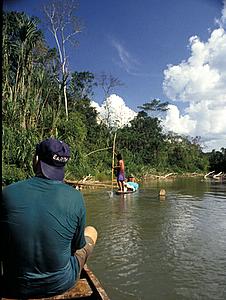
Mistake, mistake, mistake – How could I have made such a stupid
mistake. At our late lunch stop I had changed from boots to
sandals, strong sandals, the problem was not with the footwear but
with my brain which seemed to have gone into non thinking mode as
the day started to turn to twilight. We had been walking fast,
through thick rain forest and crossing and re-crossing rivers or
maybe even the same river. The last few Kilometres of the twenty
seven from our jump into the jungle to the 'Yawanawa'
village, our guides had decided to make what was a two day trek
into one. Why? I have no idea, unless it was too see how we would
make out. My legs felt like lead pillars as I walked in the river
my sandals acting like buckets holding my down feet, like walking
in treacle, my heart pounded loudly with each stride as I tried to
keep up with 'Yawanawa' Indian ahead, who was starting to
disappear in the dusk. The tribe had warned us that the rain forest
was very dangerous at night and they would always be back in the
village by nightfall! Just as I thought I could go no further and
dusk started to turn to darkness, I saw a figure on the shore about
a hundred metres away waving me on. I staggered up to Adam Baines,
for that's who it was, as he said “Well done Tony we have
made it” and we shook hands. Months of politicking in the
urban jungle, then many adventures on the way to our final
destination, the 'Yawanawa' village of Novo Esperanca – At
last we had arrived or nearly, the last hurdle or just about the
last straw, was about seventy steps cut in to the steep river bank
leading up to the village.
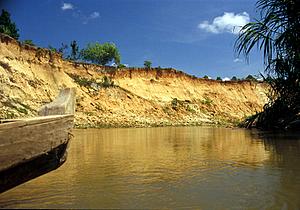
The 'Yawanawa' were early risers, the queue for the
bathroom or in this case the river started at 0415 hours for the
women and then the men from about 0445 hours. Breakfast consisted
of something from the day before, usually highly salted and
difficult to keep down as the sun started to kiss the village roofs
of the 'Yawanawa'.
Adam and I stayed in the village main
hut, a sort of Pub with no beer or village hall, were the tribe met
either to eat with the chief or discus tribal policies or problems.
This hut had one large interior room with a double bed and a
hammock, I had the hammock after a discussion that I'm not sure
if I won or lost!? There was also a kitchen, or should I say a
small room that contained a medium size gas bottled refrigerator,
used if any medicine had been air dropped to the tribe and needed
to be kept cold and a large jug of water with a tin bowl.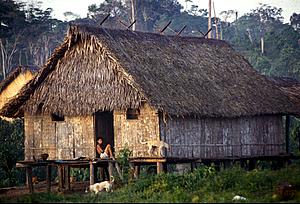 We had a
special treat one night, when the chief switched the fridge on for
a couple of hours and we had a mug of cold water that tasted as
good as any cold beer I have ever tasted.
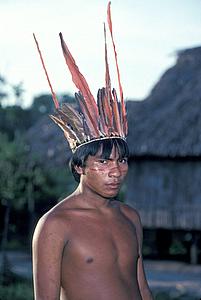
These Indigenous people had five different ways of sustaining
themselves,' in the depth of this green paradise.
The hunters split the area around the village into seven parts and
one part was never hunted on for seven years. They hunted and ate,
monkeys, deer, wild pig, various birds and some things I did not
want to know the name of. Fruit and fish were also part of their
main diet. These people were just about to experiment with having
one field for various vegetables.
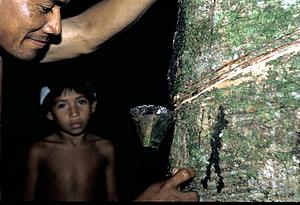
The two ways they made some money was with 'Aveda', a
Canadian firm that bought Uruku off the 'Yawanawa' for the
making of their expensive and famous make up, sold in top shops
like 'Harvey Nichols' both here, France and in North
America. The second way was with tapping the rubber and making it
into a sort of vegetable leather used in bags of all types and also
sold in quality shops in the worlds fashionable capitols.
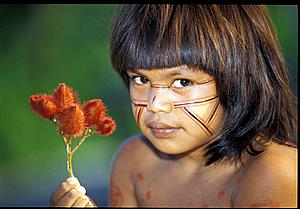 The children had half a day of school and half a day of learning
how to work like their parents, in whatever was their speciality.
The best hunters or fisherman got the best and most desirable woman
as wives. I asked why no one seemed to wear glasses or have bad
hearing? – The answer was simple nobody would marry anyone with
those problems and therefore they were bred out – Survival of the
fittest! Adam's words echoed round my brain, “Lucky you
were born in London Tony”.
The money the village made enabled them to have huts made out of
planks but in the same traditional design but better fitting than
the log version.
The tribe lived by some simple rules of the live and let live sort.
Laziness was a major sin because it let down a people that had to
pull together to survive. Daime was taken once every six weeks, the
drug that keeps your head in order, or tidies the files of your
mind. The last execution had been fifty years ago and everyone in
the tribe had to watch over the age of twelve. The idea being, that
when the 'Yawanawa' voted the death sentence, the tribe
would know the horror of execution and think carefully before
voting for death.
These people gathered on the large veranda of the main house in the
evening to eat with the chief, play cards on the only table in the
village, with a solitary candle lighting the game. Saturday night
would be dance night and they would dance until dawn of the next
day. A ghetto blaster run by a car battery, (that had been charged
by a solar panel), in one of the huts again lit by one candle,
would explode sound into the night frightening off any sort of
animal, reptile or even insect far away from the village.
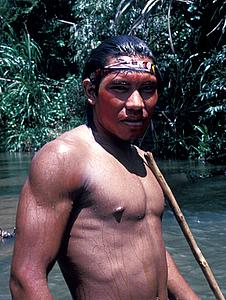
Antonio looked after the canoes and water transport; the tribe
would have its own specialists just as we do in our world. The
Chief himself would deal with the outside world business. The
Marriage with outsiders was not encouraged, The 'Yawanawa'
did not want Aids to in filter the village and also when a non
Indian married one of their girls, they tended to take the bride
out of the tribal area to live.
As the time came to leave this green paradise, I thought had it
been worth all the problems in the urban jungle, difficulties of
permissions, of hopes being raised and dashed and then raised
again. The answer of course was a big yes. Staying with
'Yawanawa' even though for a short time taught me so much
not just about the tribe but about myself as well. Everything is
possible, with determination, tenacity, time and a belief in
yourself, even when others say that your idea is impossibility.