Vacation Dreams

Tag: March 2005

  • Meeting News from New York

    We are sorry to say that for the time being, New York meetings are
    suspended as Laurie really needs a helper. If you have some time to
    spare and are based in or near NYC, please contact Laurie on the
    e-mail address below.

    For details of forthcoming meetings email newyork@globetrotters.co.uk
    or register for email updates, click
    here at our website.

    New York meetings are held at The Wings Theatre, 154 Christopher
    Street (btw Greenwich St and Washington St ), to the right of
    Crunch Fitness, in the Archive on the first Saturday of each month
    at 4 pm .


  • Holland's Bulbs

    From the end of March until May, Keukenhof gardens, Holland's
    most famous spring gardens, will burst into a kaleidoscope of
    colour as spring comes to life in a stunning display of
    breathtaking beauty. Millions of tulips and other bulb flowers will
    burst in bloom, a fantastic experience for everyone and a wonderful
    spectacle to photograph. Keukenhof is situated on the west coast of
    Holland, in the Holland Rijnland area, with its flower fields, the
    beaches of Noordwijk and Katwijk, beautiful villages and the
    historical city of Leiden. Click here for more information on Keukenhof Gardens.


  • UK Tax Free Goods

    For UK travellers returning to the UK after a shopping spree could
    be in for good news. In the recent Budget speech, the Chancellor
    Gordon Brown announced the amount travellers can bring into the UK
    tax-free is likely to rise from £145 to £1,000.


  • Meeting News from Ontario

    For information on Ontario meetings, please contact Svatka
    Hermanek: shermanek@schulich.yorku.ca
    or Bruce Weber: tel. 416-203-0911 or Paul Webb: tel. 416-694-8259.

    Meetings are held on the third Friday of January, March, May,
    September and November. Usually at the Woodsworth Co-op, Penthouse,
    133, Wilton Street in downtown Toronto at 8.00 p.m.


  • Lighters Banned in Hand Luggage in US

    Congress passed a bill last year adding lighters to the list of
    items prohibited in the cabin. The ban started mid April 2005.
    Lighters haven't been permitted in checked bags for at least 30
    years because they might start fires in cargo holds. The reason for
    the ban was the failed shoe bomber, Richard Reid, who tried
    unsuccessfully to light explosives hidden in his shoes on a
    trans-Atlantic flight in 2001. He used matches.


  • Round the World Trip in 67 hours

    On March 3, 2005 after covering 23,000 miles in 67 hours, Steve
    Fossett became the first person to fly around the world alone in a
    plane without stopping or refuelling. Fossett, 60, holds many other
    records as a balloonist, pilot and sailor.

    “I’m a really lucky guy now, I got to achieve my
    ambition,” the 60-year-old millionaire said after stepping out
    of the cramped capsule in which he had spent nearly three days.
    “It was a difficult trip … one of the hardest things
    I've ever done, to be on duty for three days, day and night,
    with virtually no sleep. It was an endurance test,” Fossett
    said.

    While Fossett is the first to make the flight alone, it will not
    enter the record books since the Paris-based Federation
    Aeronautique Internationale has said it does not have a separate
    category for solo pilots.

    Fossett's team however had said they hoped to qualify for
    distance and speed records, which remain to be certified.


  • Meeting News from Texas

    Due to bereavement in Christina's family, we regret to say that
    Texas meetings have stopped pending further notice. If you have
    time to spare and would like to take over Texas meetings, please
    contact the Beetle on: beetle@globetrotters.co.uk


  • World Photo Day 1st June 2005

    Here is a marvellous opportunity to photograph our lives and submit
    to World Photo Day.

    The World PhotoDay 2005 project is an exploration into the everyday
    lives of people on a global scale. The diversity of this planet we
    inhabit is grand beyond belief. While you are having breakfast
    reading the paper, what do you think the rest of the world is
    doing? You will find out what happens on just one single day in the
    lives of people worldwide. No one is excluded from participating –
    you can be a professional, an amateur, someone who has a 35mm
    disposable, or whatever. The intent here is to show us, humankind,
    as we are. If you are using the latest digital SLR, or a disposable
    camera, great! Submissions will not be accepted until June 1, 2005
    @ 00:01 hours GMT.

    All photos must be taken on this single day – 1st June 2005,
    please!
    Try to depict life on just one day in the world as seen
    through your eyes, the photographer. Pre-registration is required
    to participate. Submissions are limited to 1 (one) photo per
    person. This is due only to the organiser's limitations in
    handling multiple photos per individual.

    Take a look at: http://www.worldphotoday.org


  • New Travel Magazine Launched

    Readers of the Globetrotter e-newsletter may be interested in a new
    English language bi-monthly magazine aimed at the enquiring
    traveller. hidden Europe was launched on 1 March 2005. The first
    issue sets the tone for a magazine which we think fills a distinct
    niche in the market. We take our readers beyond the usual tourist
    trails. Our brief is Europe wide, and we criss-cross the continent
    to publish the very best of what's new, what's old,
    what's odd and what's fun. We promise a zany look at the
    quirkier aspects of European people and places. A good read, always
    authoritative and packed with useful information. hidden Europe
    evokes the spirit of Europe's diverse landscapes, conjures up a
    sense of place and probes the curiosities of our continent's
    varied cultures.

    Launching a new travel magazine may seem like folly at a time when
    we all suffer from information overload. But we think there's
    still a place for the quieter, more reflective, style of writing
    which we hope will become our hallmark. So in our first issue, you
    will find articles on slow food and slow trains – plus one that
    extols the merits of the slow boat. Join us on a journey that in
    this first number will lead us from rural Russia to the Scottish
    Hebrides, from Poland to Piedmont, and from Lithuania to Albania.
    Look for articles on Spanish Galicia, the Faeroe Islands and
    northern Portugal in hidden Europe 2 (in May 2005).

    hidden Europe appears in A4 format and each issue is 48 pages.
    Single copies are £4.50 and an annual subscription, including
    postage anywhere in Europe, is £27.00. hidden Europe is produced by
    Gardner & Kries GbR, a small Berlin based publisher, run by
    Susanne Kries and Nicky Gardner, two women who have travelled more
    miles than most, and both experts on aspects of European cultures,
    languages, peoples and places. Visiting every inhabited Harridan
    island and crossing 33 borders in a couple of days are just two of
    the mad things we've done in the spirit of hidden Europe. Check
    out full details of the magazine, and register for our free
    electronic newsletter, at our website on www.hiddeneurope.co.uk


  • The Spice Islands by Jon Hornbuckle

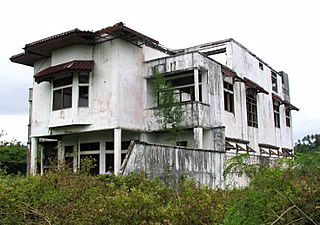
    mayor's house, bombed, Ambon city
    The killing is over on Ambon, the hub of the Moluccas, or Spice
    Islands, in Indonesia. There is an invisible line drawn between the
    Christian and Muslim sectors in the City – it is still dangerous to
    stop on the wrong side. The burnt out churches, houses and even
    university buildings are reminders of the carnage that occurred a
    short while ago, when Ambon was likened to Beirut at its worst.
    “So it was a religious war?” I enquire. “Not really,
    more the result of political manoeuvrings. Now we have peace and
    democracy, but no jobs, clean streets or reliable infrastructure,
    the opposite of neighbouring Singapore.” Almost incredibly,
    fair and trouble-free elections had just been completed, much to
    the surprise of the incumbent president, who refused to accept
    defeat. “I would rather be in the hands of the Chinese army
    than the Indonesian”, a French photo-journalist told us later,
    after describing how he had to injure himself to persuade the
    Chinese soldiers to release him. “You won't be killed or
    “disappear” in their custody.”
    market-near-hila-ambon.jpg
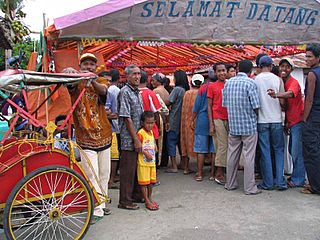
    With two friends I drove across the spine of Ambon to Hila, an old
    village overlooking the much larger island of Ceram, passing
    countless cloves and nutmegs drying in the sun on the roadside. It
    was hard to believe that centuries ago such spices were valued more
    highly than gold, with the result that the islands were a
    battle-ground for the colonial powers, ending when we swapped our
    land there for New York, after smuggling out seedlings to establish
    plantations in India! We hiked up a steep trail, through spice
    plantations, to a ridge with a spectacular view over the partially
    forested hillsides. Here we strove to observe two species of
    parrots endemic to these islands, which we could hear but not see.
    We returned early the following morning and were rewarded by the
    sight of the electric Moluccan Red Lory and the “poorly
    known”, to quote the bird book, but well-named Drab
    Honeyeater. On the drive back to the airport, we stopped to chat
    and photo the friendly locals, many of whom were Muslims.
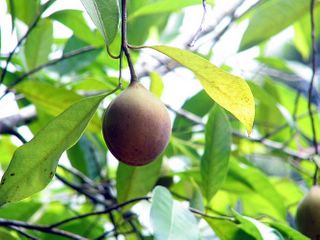
    nutmeg growing, Ambon
    The main reason for going to Ambon was to take a flight to the
    rarely visited Tanimbar Islands, some two hours east of Ambon. The
    only flights were with Merpati, whose slogan “Get the
    feeling” aptly described schedules in these parts as feelings
    were all you could rely on, with nobody outside their office in
    Ambon knowing when such flights would occur. Fortunately, we were
    able to fly to Saumlaki on Yamdena, the main island of the
    Tanimbars, on the desired day, a most uncomfortable experience in
    an ancient 22-seater. We then discovered that we could not fly to
    the relatively close Kai Islands as we wanted, flights having been
    suspended, and the flight we had “booked” back to Ambon
    did not run that day. As the previous day was full, we got a
    booking for the day after, but no tickets as the agent had gone to
    the airport to investigate why the plane had returned. The answer
    was that the pilot had felt ill and so decided to come back to
    Saumlaki, apparently not trusting his co-pilot to take-over.
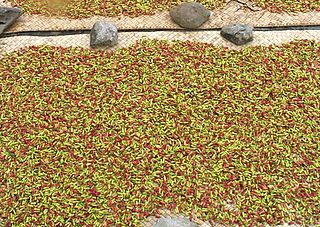
    cloves drying on road, Ambon
    The Tanimbars are at almost the south-eastern extremity of the 5000
    km long Indonesian Archipelago, only 150 km from the coast of
    Australia. Unlike most of the country, the population is
    predominantly Christian. At the Harapan Indah, the only hotel in
    town, we arranged to stay at the owners' farm 21 km along the
    island's only road, so that we had ready access to the native
    forest. By the time we reached the farm, after supplies had been
    purchased, including a crate of beer, it was raining – the first
    time for 4 months so it was said. We had come here to try to see
    the 20 or more special birds endemic to these parts, a surprisingly
    high number for such a relatively small area. When the rain
    stopped, we set forth, amongst much bird activity, but were
    disappointed to find the extensive forest reported to be present by
    the last person we knew to have visited, some 10 years ago, had
    gone and only patches of logged forest remained. ironing banknotes, Saumlaki, TanimbarsHowever, over the
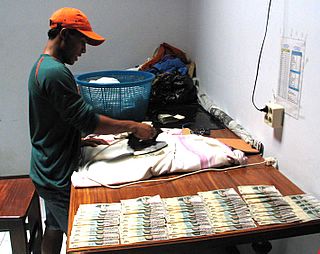
    next 4 days we saw all the specialities, including 2 parrots, 2
    thrushes and 5 flycatchers, apart from the Tanimbar Scrubfowl,
    sadly scarce or elusive due to hunting, and the Pied Bronze Cuckoo.
    Strangely, I had recorded the song of the cuckoo on the first
    afternoon, but never heard it again. According to the book, it
    parasitizes the endemic Rufous sided Gerygone, but the only bird to
    react to the playback of its song, on several occasions, was the
    Wallacean Whistler – indicating that this species is the main host
    for the cuckoo's eggs.
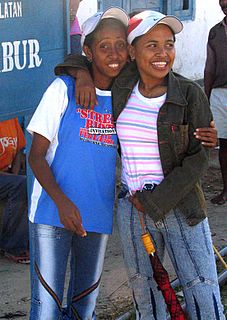
    girls at Turgham, Tanimbars
    On the last afternoon, we visited the old village of Turgham. We
    started at the mayor's house, where a meeting of the village
    elders was in progress. After mutual greetings, we signed the
    visitors book, noting that all previous visitors of the last 2-3
    years looked to be either Indonesians or Australians, the latter
    associated with the annual Darwin to Saumlaki boat race apparently.
    At a wood-carver's house we bought a number of carvings from
    the selection on offer by several local artists – good quality and
    value. We were invited to drink a glass of Soli, local spirit
    distilled from palm wine- highly alcoholic and surprisingly smooth.
    Returning to the Harapan Indah in Saumlaki, we enjoyed the
    air-conditioning, until ended by a power cut, and were amused to
    observe the staff ironing banknotes flat, perhaps to facilitate
    storage as even the smallest item can require a large number of
    notes, the exchange rate being 16, 000 Rupiah to the pound. The
    trappings of civilisation are a bit thin on the ground here: no
    mobile phone cover, internet access or shopping malls. Predictably,
    our flight was delayed by late arrival of the plane but this gave
    us chance to study the profusion of Oriental Plovers and Little
    Curlews on the runway – two species rarely encountered away from
    their wintering grounds in northern Australia. It was a shame we
    could not fly to Kai but we all agreed this last minute extension
    to our eastern Indonesia trip had been a highly rewarding and
    pleasant experience.